Satellite Weather Monitoring Transforms Real-Time Odds Adjustments in Outdoor Athletic Competitions

Weather satellites now feed continuous streams of atmospheric data into algorithms that adjust live betting odds for events held outdoors, and this integration has accelerated since early 2025 as operators seek more precise risk management tools. Data from polar-orbiting and geostationary platforms supplies details on wind speed, humidity, temperature shifts, and precipitation intensity that directly influence performance variables in sports such as tennis, golf, soccer, and marathon running. Those variables alter player stamina, ball trajectory, and field conditions, prompting odds compilers to recalculate probabilities within seconds of updated satellite readings.
Core Mechanisms Behind the Integration
Operators pull raw measurements from agencies including the National Oceanic and Atmospheric Administration along with the European Organisation for the Exploitation of Meteorological Satellites, then merge those inputs with historical performance datasets. The combined information runs through models that quantify how a sudden five-kilometer-per-hour gust might shift serve-win percentages on grass courts or how rising humidity levels above 70 percent correlate with slower marathon split times. Because the data arrives in near real time, bookmakers can push revised odds to bettors before the next point, hole, or lap begins.
Take one major tennis tournament held on outdoor hard courts in June 2026 where forecasters detected an incoming microburst using infrared satellite channels; within ninety seconds the implied probability for the favorite dropped by four percentage points and live markets reflected the change across multiple platforms. Similar adjustments appear in golf when satellite-derived wind vectors at different elevations allow oddsmakers to modify hole-by-hole over-under totals during the final round.
Data Sources and Processing Pipelines
Processing pipelines ingest readings every fifteen minutes from instruments aboard satellites positioned over key competition regions, then apply machine-learning corrections that account for terrain effects such as stadium wind tunnels or elevation changes on mountain golf courses. Research institutions like the Cooperative Institute for Meteorological Satellite Studies at the University of Wisconsin have documented how these corrections reduce forecast error margins by up to thirty percent compared with ground-station-only models. The refined forecasts enter proprietary pricing engines that also factor in team or athlete historical responses to identical weather profiles.
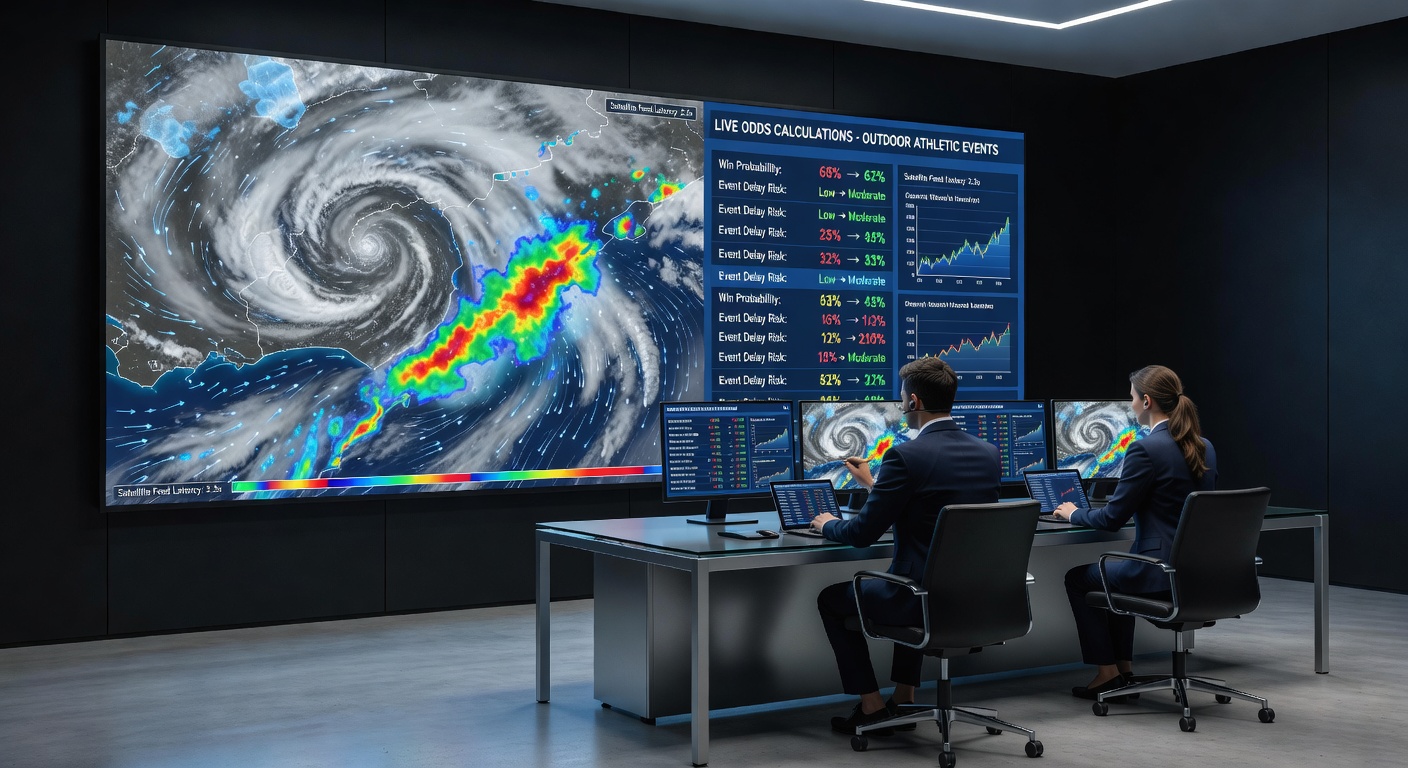
Industry reports from the Asia-Pacific Association of Gambling Studies note that several operators in Australia and Japan began testing satellite-augmented systems in late 2025, citing improved accuracy during sudden weather shifts common in coastal venues. Those tests produced measurable reductions in liability exposure during volatile periods, prompting wider adoption ahead of the 2026 outdoor season.
Impact on Specific Outdoor Disciplines
Marathon and road-racing markets illustrate the effect clearly: satellite-derived heat-stress indices now trigger automated odds movements when wet-bulb globe temperature readings exceed thresholds that historically correlate with slower finishing times. In soccer, lightning proximity alerts generated from satellite cloud-top temperature data cause temporary suspension of in-play markets until the threat passes, after which fresh lines incorporate updated pitch moisture estimates. Golf spread betting on total strokes per round incorporates real-time evapotranspiration rates calculated from satellite vegetation and humidity layers, creating narrower margins during humid afternoons versus dry mornings.
Observers note that these adjustments occur without public announcement yet remain visible in timestamped odds histories published by data aggregators. The pattern shows clusters of rapid revisions aligned with satellite overpasses rather than with on-site human reports alone.
Regulatory and Technical Considerations
Regulators in multiple jurisdictions require operators to maintain auditable records of data sources used for odds compilation, and satellite feeds now appear alongside traditional weather-station logs in those submissions. The Canadian Gaming Association has published guidelines encouraging standardized metadata tags that identify satellite-derived variables, while Australian state commissions have requested similar transparency for events staged in variable climates. Technical standards developed by the World Meteorological Organization facilitate consistent formatting so that feeds from different satellite constellations integrate without custom translation layers.
Processing latency has dropped below eight seconds for most providers, allowing live markets to remain open and responsive even when conditions change abruptly. This speed stems from edge-computing nodes positioned near major data centers that pre-process orbital streams before they reach betting servers.
Future Trajectory Through 2026 and Beyond
Additional satellite launches scheduled for late 2026 will increase temporal resolution over mid-latitude regions, supplying imagery every five minutes instead of fifteen. Those higher-frequency observations are expected to tighten confidence intervals around short-term forecasts that influence in-play propositions. Academic papers from the European Centre for Medium-Range Weather Forecasts already project further error reductions once the new instruments come online, and several operators have signaled plans to incorporate the upgraded feeds once validation completes.
The shift toward satellite-centric modeling continues to expand the set of measurable environmental variables that can be priced into live markets, while maintaining compliance with existing audit requirements across different regulatory frameworks.
Conclusion
Satellite weather data has moved from supplementary input to core driver in live odds calculations for outdoor athletic events, supported by documented processing improvements and regulatory acceptance in multiple regions. Continued satellite deployments and refined modeling techniques will sustain this integration through the remainder of 2026 and into subsequent seasons.