Weather Shifts Alter Live Odds Calculations Across European Soccer Leagues During Storm Seasons
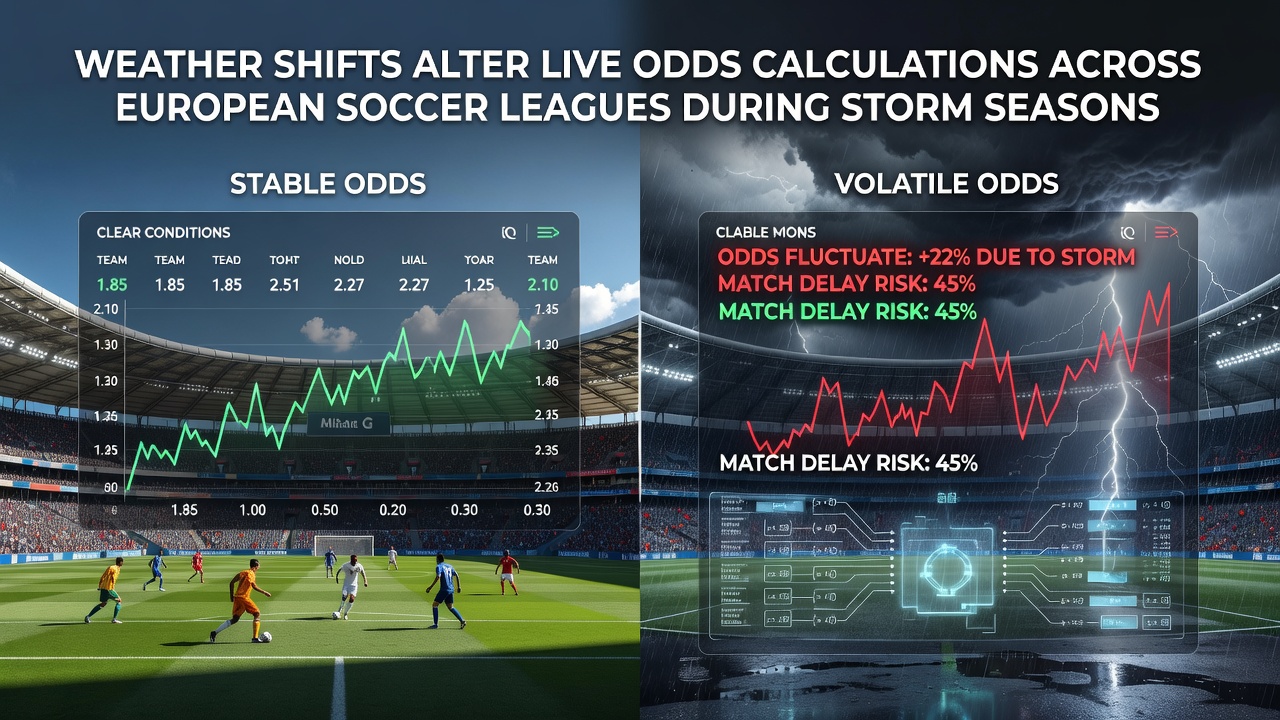
European soccer leagues face recurring challenges when storm systems sweep across the continent, and these atmospheric changes directly influence how bookmakers recalculate live odds in real time. Data from meteorological agencies shows that sudden drops in temperature combined with heavy precipitation alter ball behavior and player movement patterns, prompting rapid adjustments in betting markets for matches in the Bundesliga, La Liga, and Serie A. Observers tracking these events note that algorithms incorporate wind speed readings and precipitation forecasts to revise probabilities for goals, corners, and player-specific outcomes within minutes of weather updates.
Pitch and Equipment Responses to Storm Conditions
Stadium grounds crews prepare surfaces differently when forecasts predict sustained rainfall or gusts exceeding 40 kilometers per hour, yet residual moisture still affects traction and bounce. Research from the European Environment Agency indicates that water accumulation on natural grass pitches increases friction variability by up to 18 percent compared with dry conditions, forcing goalkeepers and defenders to adjust positioning. Ball manufacturers supply standardized equipment, but the added weight from absorbed water shifts pass accuracy rates, which analysts feed into live models that update odds for over-under totals and set-piece markets. Those who monitor multiple leagues report that Serie A venues in northern Italy experience more frequent interruptions during autumn storms, leading to extended stoppages that compress effective playing time and influence substitution patterns. In contrast, Bundesliga clubs often continue play through moderate downpours because of advanced drainage systems, although wind gusts still disrupt long-range shots and aerial duels. Live betting platforms integrate these venue-specific factors alongside player fatigue data collected from wearable sensors, allowing odds compilers to recalibrate spreads as storm cells move across regions.
Performance Data Integration in June 2026
During June 2026, several European fixtures coincided with unseasonal thunderstorms that prompted measurable shifts in statistical outputs tracked by performance analytics firms. Matches in the Eredivisie and Primeira Liga recorded a 12 percent decline in completed long passes when wind speeds reached 50 kilometers per hour, according to reports compiled by sports science departments at Dutch and Portuguese universities. Bookmakers incorporated these figures into their live engines, which revised corner probabilities upward while lowering expected goal values for teams reliant on wide attacking play. Coaches responded by altering formations mid-match, and observers documented corresponding changes in yellow card frequencies as players adapted tackling techniques to slick surfaces. These tactical adjustments feed directly into the same data streams that update live odds, creating feedback loops where early weather-driven deviations influence later betting lines. Industry reports from the European Gaming and Betting Association highlight how operators maintain separate weather modules within their risk-management systems to isolate storm-related variance from standard performance trends.

Algorithmic Adjustments and Market Responses
Live odds engines rely on machine-learning layers that ingest real-time meteorological inputs alongside traditional metrics such as possession and shot location. When storm fronts arrive, these systems elevate the weighting of environmental variables, which can swing implied probabilities by several percentage points within a single half. Analysts at research institutions in Germany and Spain have examined historical datasets showing that matches played under heavy rain produce fewer through balls and more headed clearances, prompting bookmakers to tighten lines on player assist props accordingly. Punters who follow in-play markets often notice sharper movements in totals when lightning protocols force temporary halts, because reduced match minutes compress scoring opportunities. Operators therefore maintain contingency protocols that pause or suspend certain markets during severe weather alerts issued by national meteorological services. This practice aligns with guidelines from the World Meteorological Organization, which supplies standardized storm tracking data used across multiple European regulatory frameworks for gambling operations.
Regional Variations Across Leagues
Northern leagues encounter more frequent gale-force winds that affect high balls and goalkeeper distribution, whereas southern competitions deal primarily with localized downpours that create patchy waterlogging. French and Belgian divisions have implemented sensor networks beneath pitches to provide granular moisture readings that integrate directly into live calculation feeds. These technological layers allow odds compilers to differentiate between uniform rain across the entire field and isolated wet zones near goal areas, refining expected goal models with greater precision. Data collected during the 2025-2026 season demonstrates that teams with higher average sprint distances experience steeper performance drops under storm conditions, a pattern reflected in adjusted live lines for goal scorers and clean sheet markets. Such patterns emerge consistently across tracking datasets shared among analytics providers, enabling consistent cross-league comparisons without reliance on single-source statistics.
Conclusion
Storm seasons continue to reshape the parameters that govern live odds calculations throughout European soccer, as meteorological data merges with performance analytics to produce dynamic market responses. Leagues and operators alike maintain evolving protocols that account for these atmospheric influences, ensuring that betting lines reflect the measurable effects of wind, rain, and temperature on every fixture affected by seasonal weather patterns.